Why You Should Never Put API Keys in TradingView Alert Messages
It is a tempting shortcut. You are wiring up a TradingView strategy to fire orders automatically, the receiving system asks for your exchange credentials, and...
Read more
What trading bot API key safety actually depends on: permissions, custody model, encryption, and withdrawal controls — and how to check each one before you connect.

Handing a trading bot your exchange API keys feels risky, and the instinct is healthy. Trading bot API key safety is the single biggest objection traders raise before automating a strategy — and the honest answer is: it depends entirely on what permissions the key carries and how the tool that holds it is built. A key scoped correctly and stored properly exposes you to a narrow, manageable risk. A key scoped carelessly hands a stranger your balance.
This guide walks through what an API key can and cannot do, the questions that separate safe tools from dangerous ones, and the settings you should enable on the exchange side before connecting anything.
An API key is not a password to your account. It is a credential with a specific, exchange-enforced permission set. On Binance, Bybit, Kraken, OKX, and every other major exchange, you choose what the key allows when you create it:
The permission set is enforced by the exchange itself, not by the bot. If a key was created without withdrawal permission, no software holding that key can withdraw your funds — even if the tool is compromised or malicious. This is why the first and most important rule is simple: never enable withdrawal permission on a key you give to any third-party tool. There is no legitimate reason an execution tool needs it.
This is the catastrophic failure mode. A key with withdrawal rights plus a leaked or malicious tool equals drained funds. Trade-only keys eliminate this category of loss entirely — the worst a compromised trade-only key can do is place unwanted orders, which is bad but bounded, visible, and recoverable.
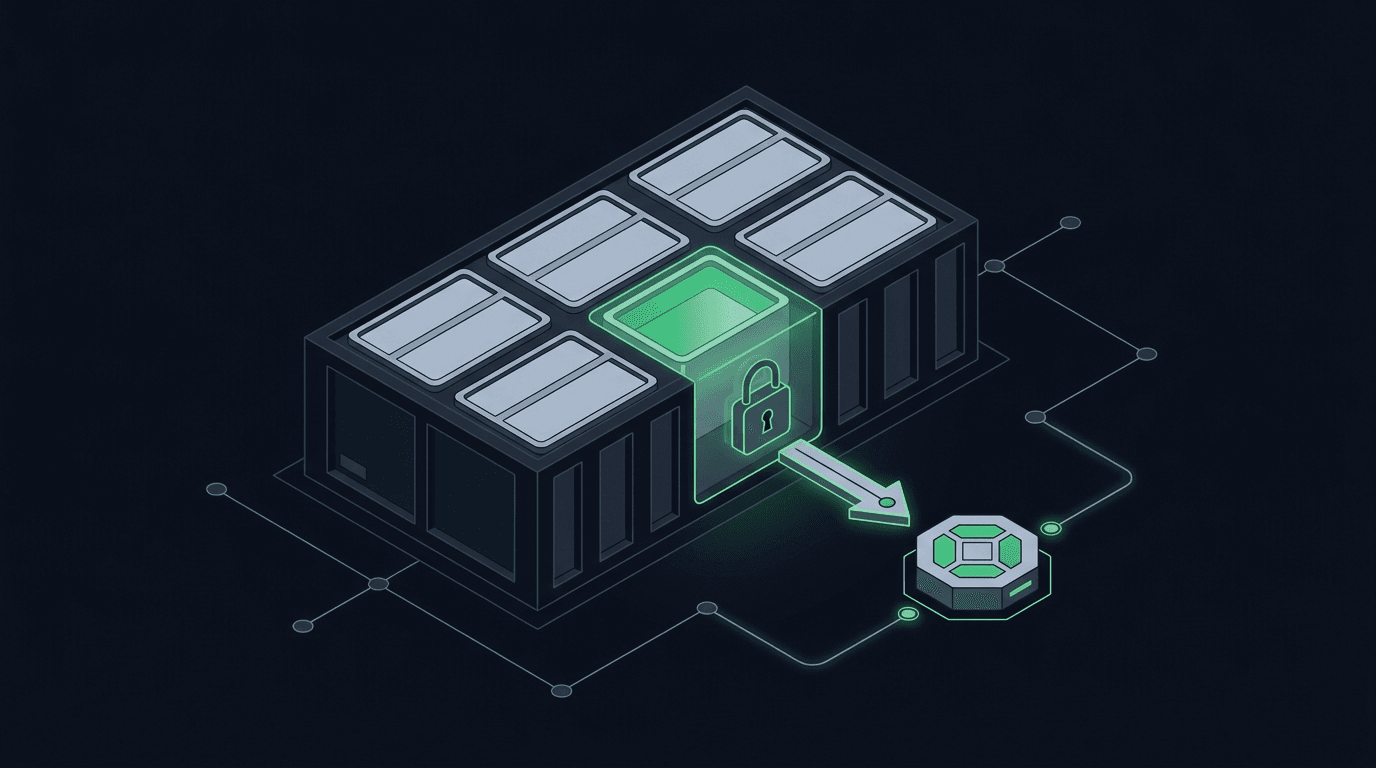
Some bot platforms ask you to deposit funds onto their platform rather than keeping them on your exchange. That changes the question from "what can this key do" to "do I trust this company with custody of my assets" — a much higher bar. A non-custodial tool never touches your funds: your assets stay on your exchange account, and your funds never leave your exchange.
Even a trade-only key should be stored encrypted at rest. A serious tool encrypts API keys with envelope encryption backed by a key management service (KMS), so a database leak alone does not expose usable credentials. If a platform cannot explain how it stores your keys, treat that silence as the answer.
Less discussed, but real: a tool that fires duplicate orders or drops signals can do financial damage with a perfectly scoped key. Look for idempotent execution — one signal should produce exactly one order, every time.
Ask these questions of any platform, including ours:
Before connecting any tool, take five minutes on the exchange side:
SignalToExchange is built non-custodial by design. We connect to your exchange with trade-only keys: we place orders, never withdrawals. Your funds never leave your exchange, keys are encrypted with KMS-backed envelope encryption, and every signal is deduplicated with idempotency keys so one signal fires exactly one order. If you are setting up automation for the first time, our TradingView webhook to exchange setup guide walks through the full flow, and the Binance automation guide covers key creation on the exchange side step by step.
Giving a bot your API keys is safe in roughly the same way handing over car keys is safe: it depends on what the keys open and who is holding them. A trade-only key, given to a non-custodial tool that encrypts credentials and deduplicates orders, carries a narrow and controllable risk — and you can revoke it at any time. A withdrawal-enabled key given to an opaque platform is a different decision entirely.
Ready to automate with keys scoped the right way? Request access / start your free trial →
Automated trading involves risk. SignalToExchange is execution infrastructure and does not provide financial advice, trading signals, or guarantees of any kind.

It is a tempting shortcut. You are wiring up a TradingView strategy to fire orders automatically, the receiving system asks for your exchange credentials, and...
You wire up a strategy, connect an API key, and let the automation run. It works. But the orders are landing on the same exchange account that holds your long-t...

When you automate crypto trading, your exchange account stops being something you log into by hand and becomes something software touches around the clock. That...
Non-custodial execution. Trade-only API keys. Independent infrastructure built for reliability.
Request Early AccessTrade-only API key enforcement. No withdrawal permissions. No custody.