What Is a Conditional (Trigger) Order and How Automation Uses It
You set up a strategy that should only act when the market reaches a specific level — buy if price breaks above resistance, or exit if it falls through support....
Read more
Webhooks vs API polling for trading signals comes down to push versus pull. Learn how each model works, how they compare on latency, reliability, rate limits, and complexity, and when to use each for automated crypto order execution.
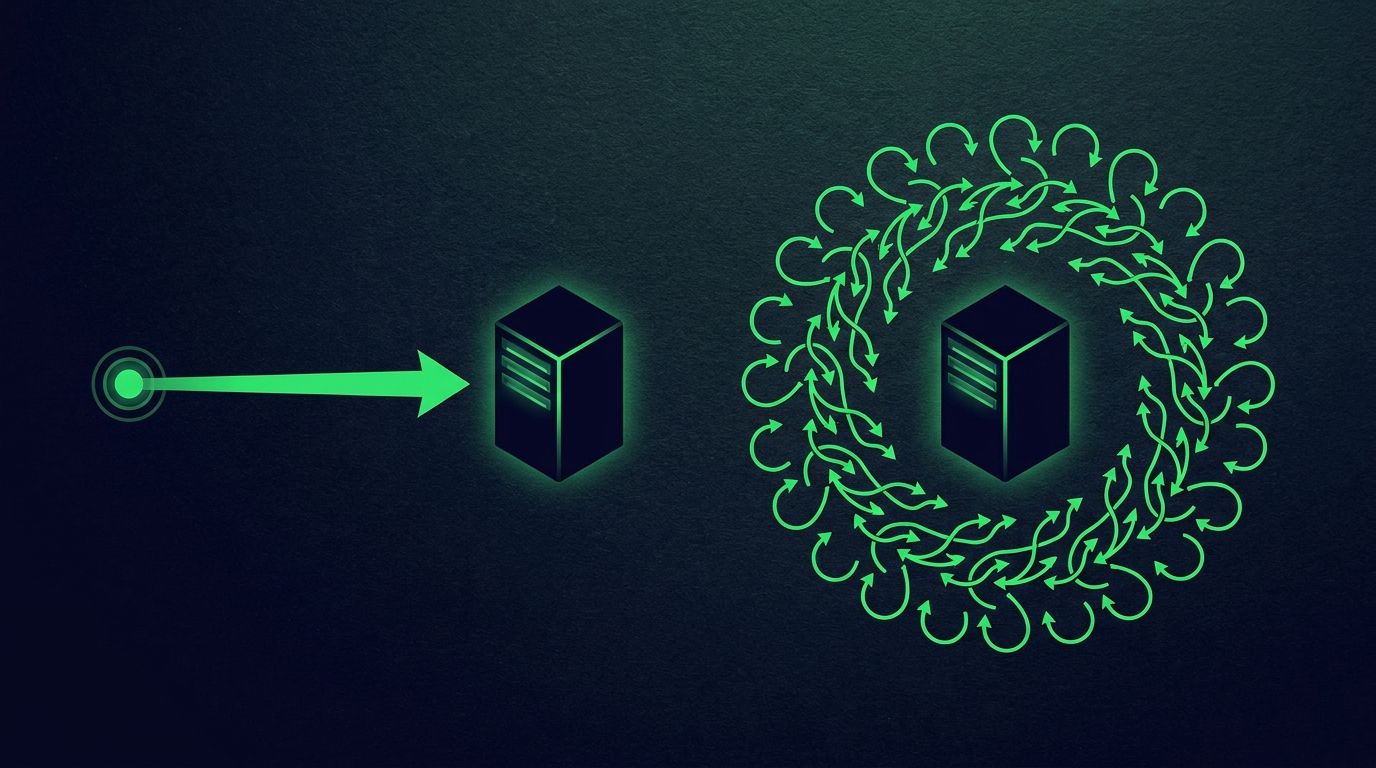
If you automate crypto trades, one architectural choice quietly shapes how fast and how reliably your orders reach the exchange: the difference between webhooks vs API polling for trading signals. Both are ways of moving a signal from where it is generated to where it is acted on, but they work in opposite directions. Polling asks, over and over, "is there anything new yet?" A webhook is told, the instant something happens, "here it is." That distinction sounds small, but in live execution it decides how much delay sits between your strategy firing and an order landing.
This guide explains what each approach does, how they compare on latency, reliability, and complexity, and when each is the right tool. It assumes you already generate signals somewhere and want them to reach an exchange without clicking anything.
Polling is a pull model. Your program repeatedly calls an endpoint on a schedule — every second, every minute — and checks whether the state has changed. If nothing has changed, the request returns nothing useful, and you wait and ask again. The consumer controls timing.
A webhook is a push model. Instead of you asking, the source system sends an HTTP request to a URL you control the moment an event occurs. You run a small receiver that listens for those inbound requests and reacts. The producer is in control of timing. If you have ever wondered what a webhook really is under the hood, it is nothing more exotic than a normal HTTP POST that arrives when something happens rather than when you ask.
The same trading signal can travel either way. The question is which model fits execution, where the value of a signal decays quickly.
In a polling setup, your automation runs a loop. On each tick it calls an API — a data feed, a database, a spreadsheet, or an exchange endpoint — and inspects the response for a new instruction. If it finds one, it submits an order. If not, it sleeps and repeats.
Polling is simple to reason about. There is no inbound endpoint to expose and no receiver to keep online, and it degrades predictably: if a poll fails, you try again next cycle. That makes it a natural fit for state you own, such as your own database of pending instructions.
The cost is baked in. Most polls return nothing, so you spend requests — and rate-limit budget — asking a question whose answer is usually "no." The interval you choose is also a direct tax on speed. Poll every 30 seconds and a signal generated one second after a poll waits 29 seconds before you even see it. Shorten the interval to reduce that lag and you multiply request volume, which runs you into exchange API rate limits faster. Polling trades latency against request budget, and you cannot fully win both.
In a webhook setup, the signal source sends a message the instant a condition is met. A TradingView alert, for example, can fire an HTTP request to your receiver at the moment your strategy crosses its trigger. There is no interval and no waiting loop — the event pushes itself to you.
For execution, this is the natural shape. The signal arrives as close to "now" as the network allows, your receiver validates it, and it moves to the exchange. If you have set up a TradingView webhook to an exchange before, you have used a push pipeline: alert fires, payload arrives, order is placed.
The tradeoff is that a webhook needs a receiver that is publicly reachable, always on, and secured. You expose an endpoint, verify inbound requests are authentic, and handle bursts when several alerts fire at once. Those are solvable but real work — which is why a dedicated relay layer exists.
Latency is where the two models separate most clearly. Polling latency is bounded by your interval: on average, a signal waits half the polling period before it is even noticed, plus the time to process and submit. Webhook latency is bounded by network and processing time, typically a fraction of a second, because the event travels the moment it exists.
For slow strategies acting on daily closes, an extra thirty seconds may be irrelevant. For anything reacting to intraday moves, that delay becomes slippage — the gap between the price your signal assumed and the price your order gets. Push delivery keeps that gap as small as your infrastructure allows.
Neither model is automatically more reliable; they fail differently.
Polling fails gracefully but silently. A missed cycle is invisible unless you instrument it, and a source that is briefly wrong simply gets re-read next tick. The risk is staleness: you can act on a value that changed between polls, or miss a short-lived event entirely if it appears and disappears inside one interval.
Webhooks fail loudly but can drop messages. If your receiver is down when an event fires, that delivery may be lost unless the sender retries. Robust webhook systems add retries, delivery confirmation, and idempotency keys so a repeated delivery does not place a duplicate order. Handling those cases well is the same discipline behind managing failed and rejected orders: assume something will fail and design the recovery path first.
Polling spends requests continuously whether or not there is news, so aggressive polling can exhaust an exchange's rate budget and get you throttled at the worst moment. Webhooks spend a request only when an event actually happens, which is far more efficient at the same responsiveness.
The complexity trade runs the other way. Polling needs no exposed endpoint and no inbound security, so it is quick to stand up. Webhooks need a hardened receiver, authentication on every inbound request, and burst handling. You are choosing between ongoing request cost and upfront infrastructure cost.
Push is the better default for execution, but polling is not obsolete. It is the right choice when:
Many real systems use both: webhooks for time-sensitive execution and polling for reconciliation, where a slower background loop confirms the exchange's state matches what your automation believes.
Whichever model you use, a few habits keep automated order flow honest:
Running a hardened webhook receiver — always online, authenticated, burst-tolerant, idempotent — is the part most traders would rather not build. That is the gap SignalToExchange fills: it is a non-custodial relay layer that receives your signals over webhook, validates each one, and submits the resulting order to your exchange with low latency. You keep the strategy; the relay handles reliable delivery.
Because the model is non-custodial, your funds never leave your exchange. You connect trade-only API keys with no withdrawal access, so the relay can place and manage orders but can never move your money. If you are ready to stop maintaining your own receiver, you can request access and start a free trial to route signals through infrastructure built for it.
In practice, yes, for event-driven execution. A webhook delivers the instant an event occurs, while polling can only notice a change on its next scheduled check. The only way polling approaches webhook speed is to poll extremely often, which burns request budget and pushes you toward rate limits.
Absolutely, and many systems do. A common pattern is webhooks for time-sensitive order execution and a slower polling loop for reconciliation — periodically confirming that your exchange's actual positions and orders match what your automation expects.
TradingView alerts push out via webhooks: when your alert condition triggers, TradingView sends an HTTP request to the URL you provide. It offers no polling API for retail alerts, so push is the standard way to automate from TradingView.
Without retries, that delivery can be lost. This is why production webhook systems add retry logic, delivery confirmation, and idempotency keys. A managed relay removes this concern — keeping the receiver online and retry-safe is its job, not yours.
No. A non-custodial relay uses trade-only API keys, which let it place orders but not withdraw. Your balance stays on your own exchange, and the relay only ever has permission to trade, never to move funds off the platform.
Automated trading involves risk. SignalToExchange is execution infrastructure and does not provide financial advice, trading signals, or guarantees of any kind.
You set up a strategy that should only act when the market reaches a specific level — buy if price breaks above resistance, or exit if it falls through support....
If you automate futures trading, you have probably noticed something confusing: your chart shows one price, but your position's liquidation level and profit-and...
You set a take-profit and a stop-loss on the same position, walk away, and expect the exchange to close the trade at whichever level hits first. On most exchan...
Non-custodial execution. Trade-only API keys. Independent infrastructure built for reliability.
Request Early AccessTrade-only API key enforcement. No withdrawal permissions. No custody.