Why You Should Never Put API Keys in TradingView Alert Messages
It is a tempting shortcut. You are wiring up a TradingView strategy to fire orders automatically, the receiving system asks for your exchange credentials, and...
Read more
The non-custodial meaning in crypto, explained plainly: where your funds stay, what your API keys can do, and how to verify a tool never takes custody before you connect it.
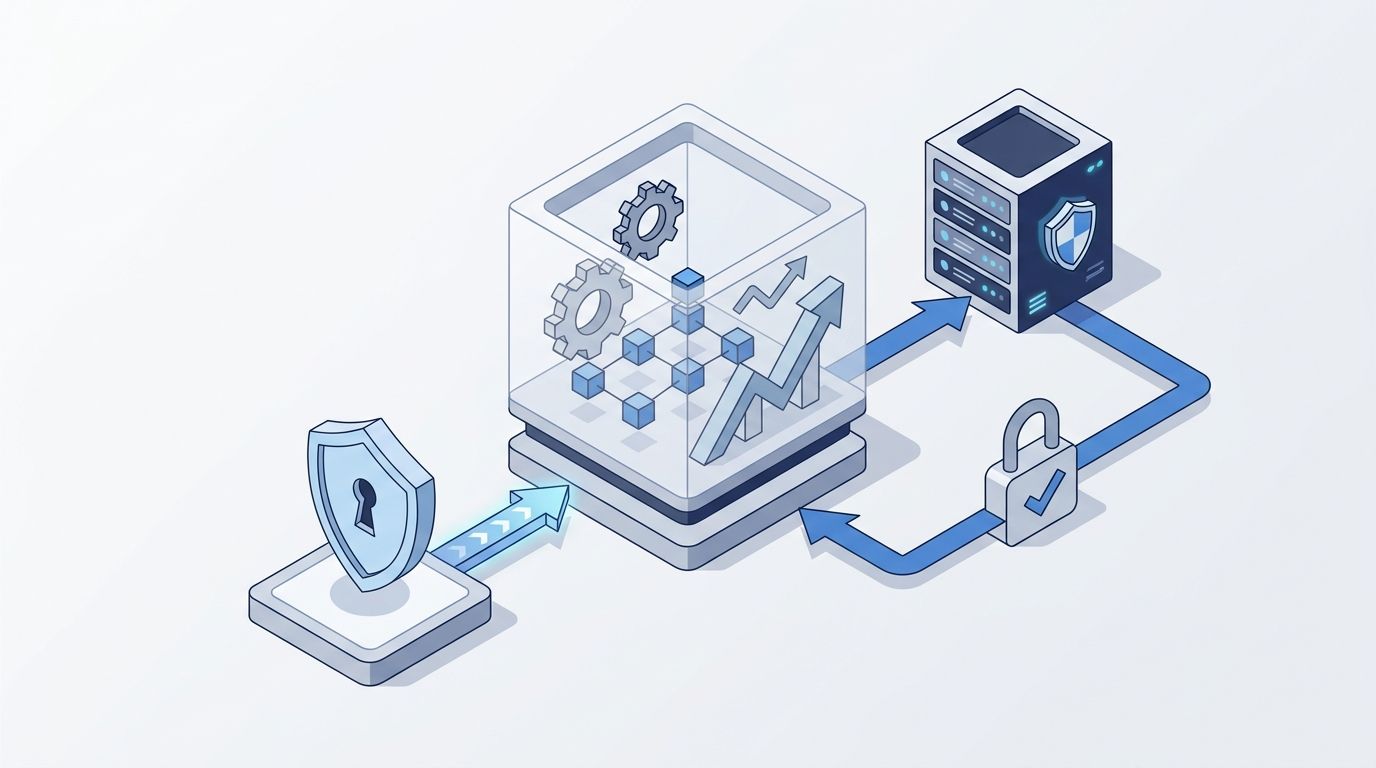
If you have looked at any crypto automation tool, you have probably seen the word non-custodial in the marketing. It sounds reassuring, but it is rarely explained. So here is the non-custodial meaning in plain crypto terms: a non-custodial tool never takes possession of your funds. Your coins stay in your own exchange account, under your control, and the tool only connects through the exchange API to do a specific, limited job. Custodial tools, by contrast, hold your money for you. That one difference shapes everything about your risk, and it is worth understanding before you connect anything.
This guide explains what the term really means, why it matters for your trades, and how to verify a tool's claim instead of taking it on faith. We will not recommend a strategy or promise any outcome — the goal is simply to help you understand who controls your assets.
Custody answers a single question: who is holding your money right now? With a custodial service, you deposit crypto into an account the provider controls. It trades from that pooled balance, and your funds sit with the company until you withdraw them. You are trusting its security, its solvency, and its honesty with your actual balance.
With a non-custodial service, you never deposit anything. Your assets remain in the exchange account you already opened — Binance, Bybit, Kraken, whichever you use. The tool connects over the exchange API and can act on your behalf, but it cannot move your coins out of your account. As we like to put it: your funds never leave your exchange.
Notice that this has nothing to do with how many indicators a tool supports or how slick its dashboard looks. Custody is structural. A tool either holds your money or it does not, and that determines what can go wrong.
The practical impact shows up the moment something fails. If a custodial platform is hacked, becomes insolvent, or freezes withdrawals, your balance is directly exposed because your balance is what it holds. Recovering funds is out of your hands.
With a non-custodial setup, the blast radius is far smaller. The worst a compromised tool can do is bounded by what your API key allows — and a well-designed execution tool asks only for permission to place orders, never to withdraw. So even in a worst case, an attacker could place unwanted trades, but could not drain your account. Unwanted orders are visible, bounded, and recoverable. Missing coins are not. For a side-by-side breakdown of the two models, see our guide on custodial vs non-custodial trading bots.
Here is the part the marketing usually skips: non-custodial design only protects you if the connection is scoped correctly. Crypto exchanges let you create API keys with separate permissions for reading data, placing trades, and making withdrawals. Crucially, the exchange enforces those limits — not the software holding the key.
An execution tool has no legitimate reason to withdraw funds. It needs to place and cancel orders, and nothing more. The safest connection is a dedicated trade-only key: the tool places orders, never withdrawals. When withdrawal permission is disabled at the exchange, even a fully compromised key cannot move your assets. If you are setting this up for the first time, our walkthrough on why trade-only API keys matter and how to set them up covers it step by step.
Anyone can write "non-custodial" on a landing page. Check the mechanics instead. Run through these questions for any tool you are evaluating:
SignalToExchange is non-custodial by design. It is execution infrastructure: it takes a structured signal — from TradingView, a bot, or any webhook source — validates it against your rules, and routes it to your exchange as a correctly formatted order. It never takes deposits, never holds balances, and connects using trade-only keys that are encrypted at rest. You keep custody, you keep the kill switch, and one signal fires exactly one order.
If you want a secure, non-custodial way to turn your existing signals into exchange orders, Request access / start your free trial →
Automated trading involves risk. SignalToExchange is execution infrastructure and does not provide financial advice, trading signals, or guarantees of any kind.
It is a tempting shortcut. You are wiring up a TradingView strategy to fire orders automatically, the receiving system asks for your exchange credentials, and...
You wire up a strategy, connect an API key, and let the automation run. It works. But the orders are landing on the same exchange account that holds your long-t...

When you automate crypto trading, your exchange account stops being something you log into by hand and becomes something software touches around the clock. That...
Non-custodial execution. Trade-only API keys. Independent infrastructure built for reliability.
Request Early AccessTrade-only API key enforcement. No withdrawal permissions. No custody.